


NEWS
Reagent-free COD versus the standard method

During our visit to Ambientalys, we asked Andrea what she thought about working with BILANZ QUALITAT® portable probes compared with the traditional method for measuring COD. She replied:
«There are no long waiting times; compared with other analytical techniques, you save time and money. We get a reading in 10 seconds instead of the usual 2 hours.
It is eco-friendly, as no waste is generated, whereas closed-tube COD involves working with chromates, silver sulphate and mercury compounds.
We save on reagents, as the device does not need any.
It is very well suited to difficult samples, especially seawater with a conductivity of between 35 and 65 mS/cm, as chlorides do not affect the measurement.
I also find it very useful for monitoring discharges easily and finding out on site how much oxidisable matter is being discharged.
An added benefit is that, at the same time as measuring COD, the instrument also gives BOD and TOC values, so we obtain 3 important parameters at once».
«It takes us longer to take it out of the case and switch it on than to take the measurements».
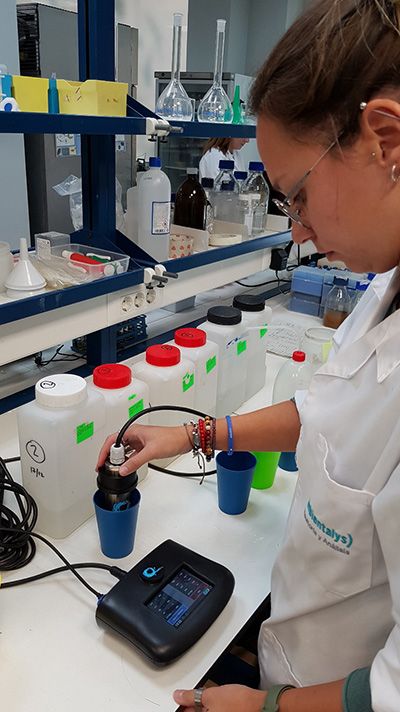
A measurement with the standard method takes 2 hours, plus sample preparation and sampling time. With the new method, 720 measurements can be taken in the same 2-hour period, compared with just 1 using the traditional method, so a test can easily be repeated if any issue is detected.
The standard method requires a spectrophotometer, reagent, thermoreactor and a 230 V power supply. BILANZ QUALITAT® portable instruments need neither reagents nor a thermoreactor. What is more, they run on 5 V, so they can operate on their own internal battery or a small external battery, even for whole days.
This is a major advantage because, in most discharge monitoring applications, power supply is difficult as there is no nearby electrical connection; battery-powered instruments are therefore the only solution.
The probes use an optical measuring principle, measuring in the infrared and ultraviolet range. The probe is made of titanium, its light source is an LED and the lens is quartz. This makes it extremely robust, suitable for field work, with minimal maintenance: the probes simply need periodic cleaning and calibration.
Measurements are taken in real time every 10 seconds and logged automatically in the instrument, from where they can be downloaded and analysed later. Data are exported as an Excel-compatible CSV file that can be processed free of charge for further study, with no licence costs.
This allows a greater number of measurements to be taken and facilities or discharges to be mapped and characterised in real time.
Savings on reagents and the subsequent management of their waste are also a very significant added benefit, both economically and environmentally.
In addition to the cost savings on COD, the instrument also measures BOD and TOC, so the operational savings are much greater. BOD and TOC also take 10 seconds to measure, compared with 5 days for BOD5.
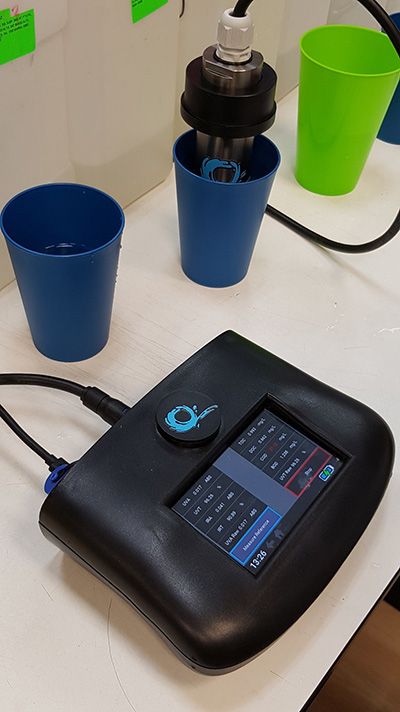
Their compact size and battery power make them easy to install in inspection chambers and monitoring gullies. The instrument itself can also be placed inside manholes with no external system visible.
The instrument has an automatic mode so it can be left measuring continuously at any point as if it were a fixed analyser, and it can log data from any watercourse or reservoir for up to 10 years.


